Case Studies
Customer: Urban & Civic Value: £38.9m Duration: 17 months
Scope of works:
This project included major structural refurbishment of the existing Rugby Radio Station building into a new educational campus to form a new teaching block, main entrance and dining hall. Two new teaching blocks for STEM and Humanities, a new Sports Hall which will include teaching areas, office accommodation and changing rooms.
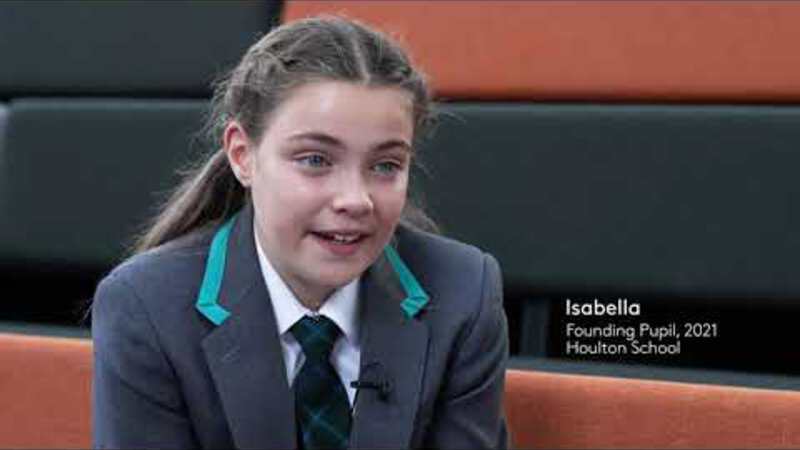
Just one week before the UK went into lockdown in March 2020, we began work on the former Grade II listed GPO Radio Transmitter building to make way for Houlton School - a unique free academy, created in order to meet the needs of the Section 106 Agreement for the 6,200 homes being built in the community.
Lockdown was only the start of the challenges during this project. Due to its Grade II listing, there was a unique complexity to the build, as we needed to restore and match centuries-old brickwork, refurbish the sprawling windows and add substantial square footage to the space without losing its history.
The project challenges were overcome by a creative mix of collaboration between all parties which meant that our specialist supply chain were able to get involved during the design phase, allowing us to lean on their expertise and innovation in listed buildings.
Straight away we met with with Historic England and the conservationists to understand the programme of works.
Thanks to a collaborative effort, Houlton School was delivered on time, within budget, scoring 10/10 for customer satisfaction, whilst reinvesting £22.4 million of social value locally.
This project overcame the challenges faced during the pandemic to not only become the heart of what will become a thriving new community, but the perfect legacy to an internationally significant heritage asset.
We’ve delivered on our promise to make the history of this site part of its future. It has been possible because of the collective efforts, the collaboration, of a whole variety of partners that are invested in the transformation of Houlton and Rugby.
Scope:
The 10 Tonne Challenge was for our project teams and supply chain to work together in order to reduce their project carbon emissions by a minimum of 10 tonnes. The main focus was to encourage greater innovation and transparency of product emissions in the supply chain and a opportunity to capture some best practice across the industry.
We worked with our supply chain partner, Selwood, in a bid to switch to a lower carbon fuel for pumping operations.
We switched to a lower carbon fuel alternative that produced approximately 90% less emissions than red diesel, improved local air quality - with a 30% reduction in emissions in N0x - and lowered particulate levels by over 86% (PM25 & PM100). Both of these pollutants are harmful to the public’s health and the environment.
The Hydrotreated Vegetable Oil (HVO) we switched to, is also more sustainable as is manufactured from renewable plant matter and is a high quality alternative to diesel.
Working in collaboration with our supply chain partners, Border Steelwork Structures Ltd and Arcelor Mittal, we were able to deliver a huge embodied CO2 saving by switching materials for lower carbon alternatives.
Adhering to the typical embodied carbon benchmark for structural steel, we sourced a low carbon alternative steel for the larger sections of the building and saved an estimated 551 tonnes CO2e.
Alongside this, Border Steel found 320 tonnes of steel beams and columns from Arcelor Mittal, which are produced with arc furnace technology to significantly reduce the carbon associated with the manufacturing process - even if you take into account the shipping overseas and into the UK.
Based on the RICS (Royal Institution of Chartered Surveyors) benchmark, the project saved an estimated 10 tonnes CO2e with one simple change: using Hy-Ten for the reinforcement. Working in collaboration with supply chain partners Chartrange Ltd, the project sourced an alterative steel reinforcement from Hy-Ten. The Environmental Product Declaration shows the embodied carbon for the Hy-ten product to be lower than the default generic value. We also used CarboniCa to calculate the embodied carbon savings.