University of Salford
BIM, Material Passports, and DIMS within construction
The University of Salford is the UK lead in this Horizon Europe project, closely collaborating with Morgan Sindall, BIMBox, University of Manchester and Lecycle, as well as the rest of the RECONMATIC consortium, to deliver digital solutions for...
Meet the team
The University of Salford is the UK lead in this Horizon Europe project, closely collaborating with Morgan Sindall, BIMBox, University of Manchester and Lecycle, as well as the rest of the RECONMATIC consortium, to deliver digital solutions for circularity in construction. This participation runs across eight work packages, including communication and management.
Building Information Modelling (BIM) is a collaborative, digital process for creating and managing information throughout the entire lifecycle of a built asset—from design and construction to operation and maintenance. It involves generating 3D models that contain intelligent, structured data about the physical and functional characteristics of a facility.
Process, Not Just Technology: BIM is a way of working, supported by tools, that enable collaborative sharing of information.
Lifecycle Management: It covers the full lifespan, including design, construction, operation, and renovation/demolition.
Information management: It goes beyond 3D drawing and geometry definition to include "data-rich" objects (e.g., technical specs, costs, material types, environmental performance).
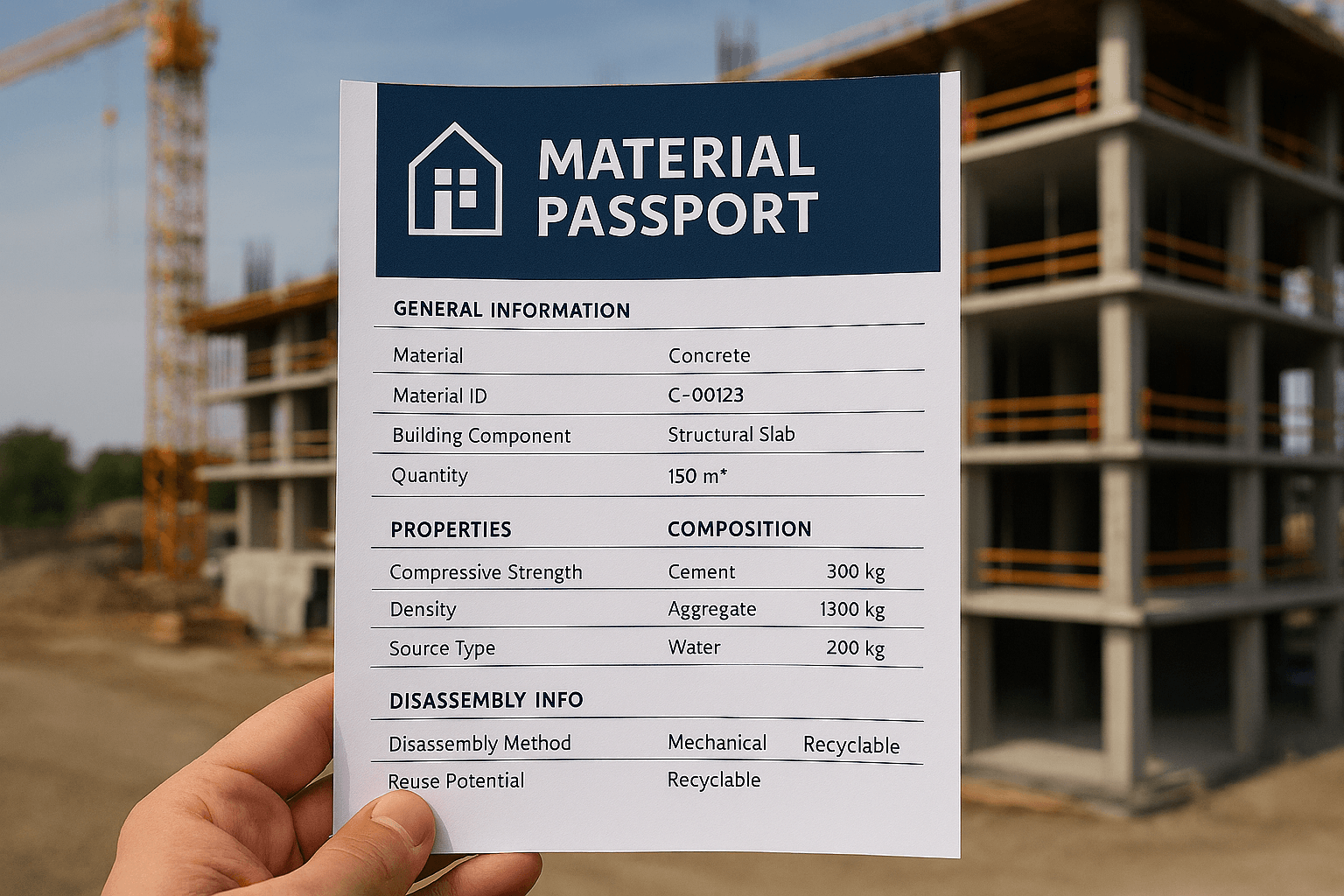
A material passport (MP) is an instrument providing digitised qualitative and/or quantitative information on the main characteristics of a product (or a building) to enable circular strategies for narrowing, slowing, closing, and regenerating resource loops. (Konietzko et el., 2021).
Material, building or product passports can be described as an instrument that offers a platform and repository for storing, linking and providing relevant information actors along the value chain. (Buildings as Material Banks, BAMB, 2020)
The EU and the UK have introduced Digital Product Passports (DPPs) and Digital Building Logbooks to accelerate the uptake of Circular Economy in the market.* MPs have some similarities and differences between these tools.
*(EU Construction Product Regulation,2024; UK Construction Product Reform White Paper, 2026)
(Amended from Cetin et al., 2023)
Digital product passports
Material passports
Digital building logbooks
Scale
Product
Area, complex, building, element, product, material, raw material
Building
Industry
Cross-industry
(Mainly) built environment
Built environment
Regulation
EU ecodesign directive
-
EU-wide framework for a Digital Building Logbook
A DPP is a mechanism for electronically registering, processing and sharing product information between producers, businesses, authorities and consumers.
It provides clear, structured and accessible data on products, characteristics and components, the origin of materials, production methods and any other relevant information. The objective of the DPP is to simplify digital access to relevant product-specific information on sustainability, traceability, circularity, and legal compliance.
According to Construction Products Regulation (CPR) 2024
the declaration of performance and conformity;
the general product information, instructions for use and safety information;
the technical documentation;
the label;
the unique identifier;
documentation required under other EU law applicable to the product; and
the data carrier (the barcode, QR code or data matrix that links to the digital file for that product).
January 2027 is the timeline set to come into effect. The European Commission will manage a register that will make the DPPs available. This will store the unique identifiers of the manufacturer, the product, and the installation. It will hold the digital records that the DPPs link to for 25 years.
Automated Data Generation: BIM models (using tools like Revit/IFC) act as the primary data source to create, populate, and update material passports, reducing manual entry and errors.
Traceability and Life Cycle Assessment (LCA): By integrating MP data into BIM, designers can perform real-time tracking of embedded materials, calculating LCA and embodied carbon from the design phase to demolition.
Circular Economy and Material Banks: BIM-based passports enable "Buildings as Material Banks" (BAMB), treating the structure as a temporary repository of materials rather than future waste.
Enhanced Decision-Making: This integration allows stakeholders to visualize and compare material variants, ensuring choices support deconstruction, material recovery, and long-term sustainability.
Workflow Integration: Platforms like Madaster or Circuland use IFC files from BIM to populate material data, which can then be used to manage, reuse, and track the circularity of building components. Other product and material data banks from manufacturers and different hubs are other sources of product data.
Digital technologies are being introduced in the construction sector, and specifically in construction and demolition waste (CDW) management and circularity.
Technology
Functions in CDWM
BIM
Lifecycle management, collaboration, clash detection, identification of enriched-data objects
IoT
Real-time monitoring, integration with BIM
Unique identifiers (e.g. (GTIN, SKU)
Product identification and tracking, integration with BIM
Digital Twin
Real-time data synchronization, life cycle analysis, demolition planning
Augmented Reality (AR)
Enhanced assembly/disassembly processes, skills training
AI & ML
Automated waste detection, predictive modelling
Robotics
Automated sorting, material classification
3D/Laser Scanning
Material quantity estimation, pre-demolition audits
XRF Devices
Rapid elemental analysis, contamination detection
In a non-integrated scenario:
Waste management practices remain fragmented.
Collaboration and information sharing among stakeholders become difficult, which hinders effective decision-making and resource optimisation.
Transparency and accountability are compromised, making it challenging to track waste generation, disposal, and recycling.
Extant literature review identified the main gaps concerning the integration of industry 4.0 technologies to support construction waste management:
Absence of comprehensive digital information management systems that encompasses the entire project lifecycle from design to demolition.
Lack of clarity regarding the roles and engagements of various stakeholders within these systems.
There are no systems found, that focuses on the integration of industry 4.0 for material flow analysis.
The aim of this research is to develop a Digital Information Management System (DIMS) that integrates Industry 4.0 Technologies to facilitate construction and demolition waste (CDW) management, to facilitate material flow analysis, as a decision-making tool for moving towards a circular economy.
The DIMS will address the identified gaps by providing a comprehensive digital solution that covers the entire lifecycle of the project, defines the roles of stakeholders, clarifies their engagement within the digital system, ensuring real-time data collection, and data security.
DIMS can:
Appropriately collect, store, process, monitor, and analyze data across construction projects, following the principles of material flow analysis.
Facilitate data sharing among stakeholders, collaboration, and interoperability and helps to support and enhance decision-making throughout the construction supply chain leading to improvement in performance.
In construction and demolition waste supply chain, DIMS is beneficial to improve:
Launching DIMS and integrating it with other platforms need a proper plan to coordinate all the stakeholders through providing sufficient training and monitoring accompanying with follow-up efforts. Some of the challenges in developing and implementing the DIMS are shown here.
Initialising a new system can be challenge most of the times due to resistance to change, lack of knowledge of engaged stakeholders, complexity of new tools which can slow down the process of establishing the systems like DIMS.
Considering the upcoming challenges and applying them in design phase can significantly reduce inconsistencies and enhance compliance with the needs of user and environment.
We designed the features of DIMS based on material flow analysis and real-world requirements in the construction and demolition waste life cycle to cover a wide range of needs in different stages based on the interaction of stakeholders and their needs.
The main goal is to generate insightful inventory reports for products and waste based on the raw data injected into the system. Following the RIBA Plan of Works 2020, the process starts with initialization of basic data in definition scope, and it continues with adding product and material data by BIM files, processing, and storing data in database at design stage.
In stage 4, other stakeholders will be engaged in the process of data manipulation by adding and editing inputted data. Additionally, we adhere to data exchange so that users can import different types of data from other sources such as manufacturer, databases, and digital product passport. Consequently, product and waste report are generated in that last stage (5) based on the pertinent data in the previous stages including product delivery monitoring and waste tracking.
The development of DIMS have progressed following the steps outlined below, enabling to collate the required data for product and waste tracking. Furthermore, smart technologies and machine learning models are included for process and prediction to facilitate data exchange. At the end, the process will show the material flow along the construction stage, with future opportunities of development to complete the asset whole life cycle.